Shopping center marketing is undergoing a profound transformation, accelerated by the digitalization of communication and changing customer behavior. While manual content creation and linear campaign planning dominated in the past, marketing today operates in an environment of significantly higher complexity.
Key factors driving this change include:
- Fragmented audience:Visitors come with different languages, cultural expectations, and information needs.
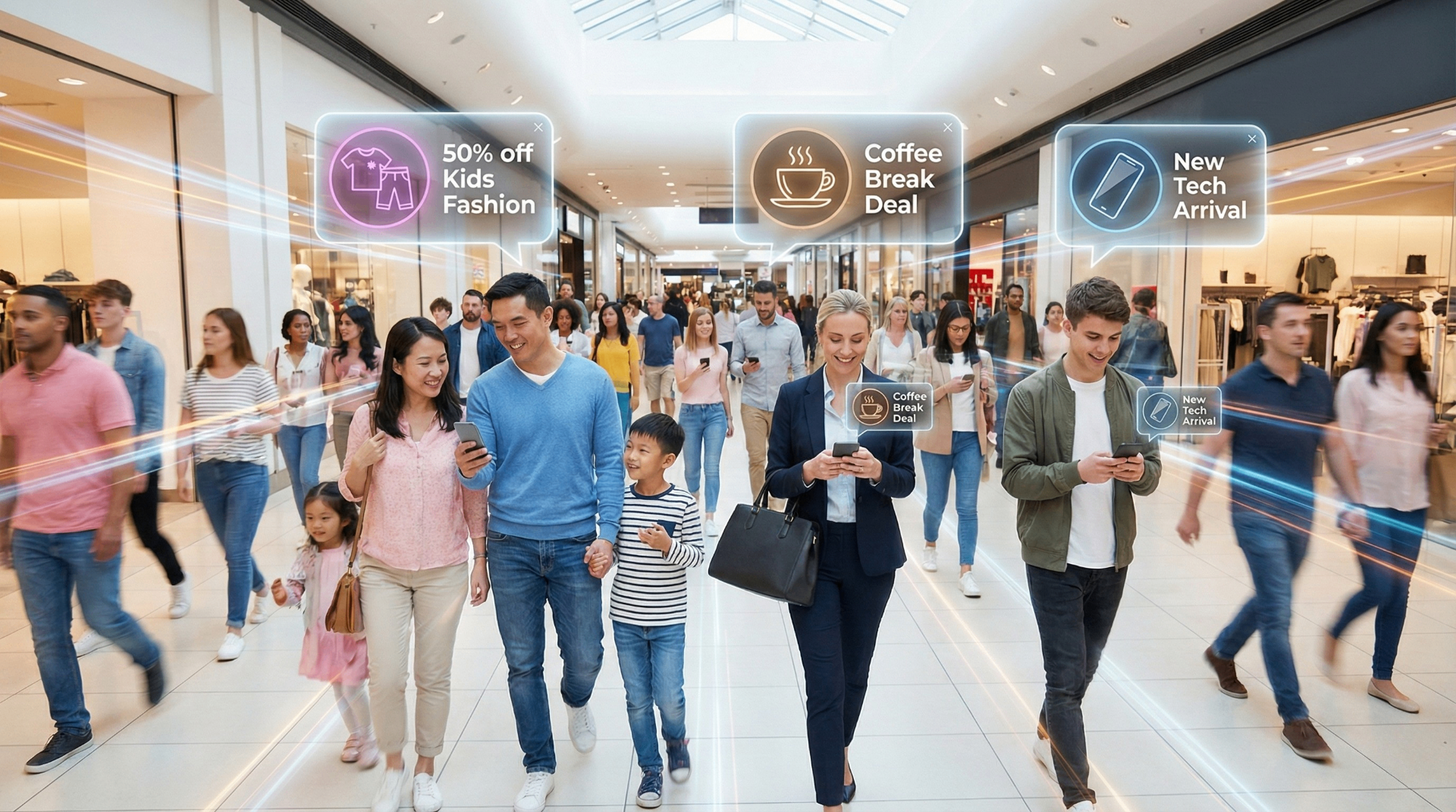
- Multichannel environment:Customers expect a consistent experience across websites, mobile apps, digital screens, newsletters, push notifications, and other channels.
- Speed of communication:News, promotions, or program changes must be published in real time, not only during planned campaigns.
These factors place continuous pressure on marketing teams to generate relevant content quickly, accurately, and across multiple languages. Traditional manual processes are no longer sustainable under these demands.
1. Marketing Challenges Specific to Shopping Centers
Fragmented Audience and Multilingual Environment
Marketing in shopping centers is more complex than in standard retail or e-commerce. Centers communicate not only their own messages but often content related to dozens of tenants, local events, and seasonal activities. Each piece of information must also be available in multiple languages and adapted to local context.
Traditionally, this means duplicating work: creating the text, translating it, and then adjusting it locally. This process is time-consuming and resource-intensive.
Pressure on Communication Speed
In a competitive environment, every hour counts. Delays caused by approvals, revisions, or translations can result in content being published after its relevance has significantly decreased. Operational reality in shopping centers requires the ability to react instantly, which traditional workflows often cannot provide.
2. Transition from Manual Content Creation to Automated Solutions
Automation and artificial intelligence are no longer the future of marketing—they are the standard. Current data confirm rapid AI adoption across the industry:
Key Industry Statistics
- Over 80% of marketing teams actively use generative AI and report clear ROI from these tools (TechRadar).
- AI is widely used for content creation, personalization, and customer segmentation across channels (SQ Magazine).
- Nearly 92% of companies plan to invest further in generative AI within the next three years (TechKV).
These trends demonstrate that AI is becoming an integral part of daily marketing processes rather than a supplementary tool.
3. AI as a Strategic Tool, Not a Technological Add-On
Generative AI is no longer experimental. In shopping center marketing, it plays a strategic role and directly influences efficiency and communication quality.
In practice, AI:
- accelerates the creation of texts, copy, and translations,
- automates routine operational tasks,
- enables real-time data-driven segmentation.
2024–2025 Data:
- 88% of marketers use AI daily, primarily for content creation and personalization (TechKV).
- 86% of brands report significant improvements in their ability to personalize communication thanks to AI (SQ Magazine).
AI has thus become a core mechanism of competitiveness, not an optional technological upgrade.
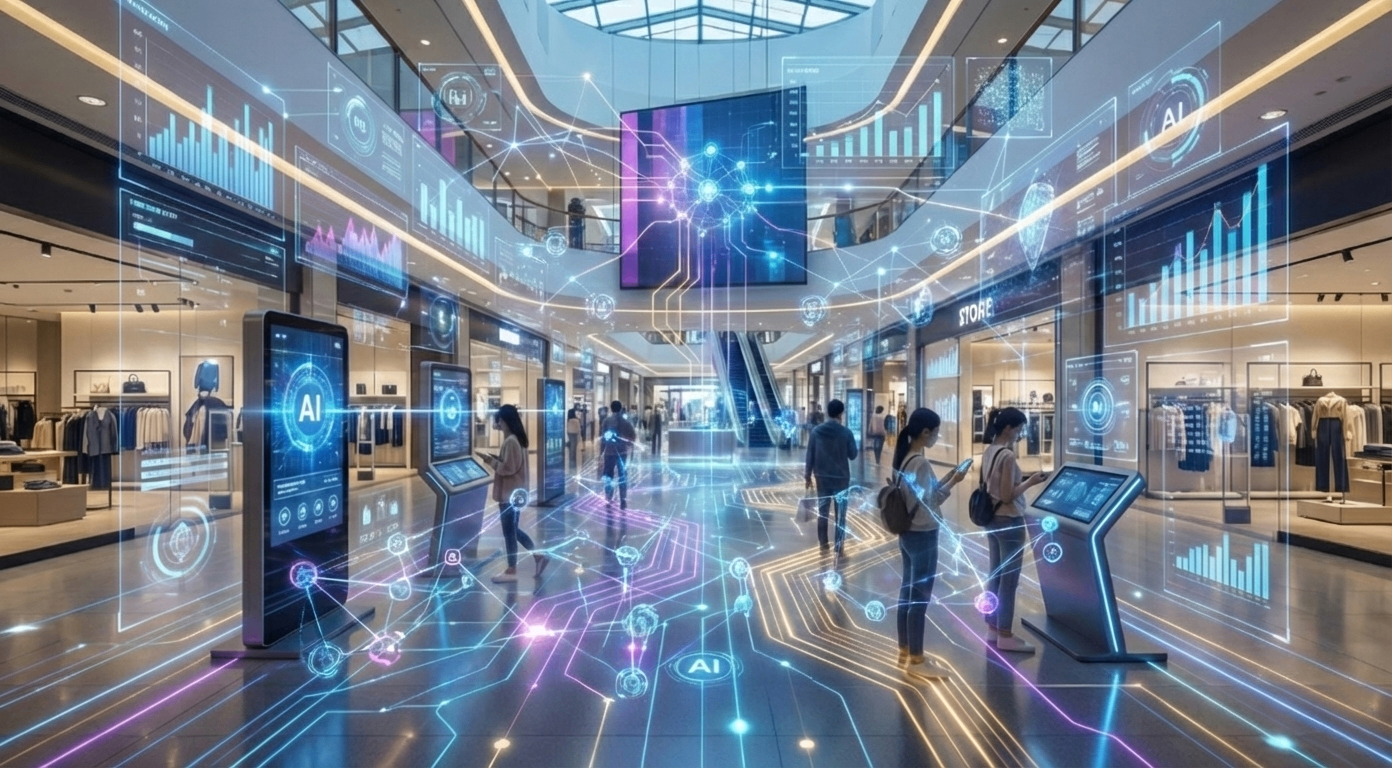
4. AI as a Tool for Marketing Content Generation
Types of Content Suitable for Automation
Certain types of information in shopping centers offer the highest value for automation:
a) News and operational updates
Structured, frequently updated content, such as opening hours, operational changes, or new stores, is ideal for automated generation.
b) Events and supporting programs
AI can create event descriptions, agendas, and key participation information with minimal latency, which is critical for time-sensitive activities.
c) Discounts, promotions, and loyalty rewards
From prepared input materials, AI can generate consistent, clear content optimized for multiple channels.
5. Generic vs. Personalized Content
While generic content serves an informational function, it is insufficient for customer-oriented marketing. AI enables:
- Hyper-personalization based on user behavior,
- Real-time text adjustments according to language and cultural nuances,
- Channel-specific content optimization (web, apps, digital screens).
Impact of Personalization:
- 48% of push notifications are now personalized using AI (SQ Magazine).
- Personalization in loyalty programs has increased customer retention by up to 27% (SQ Magazine).
6. Consistency of Communication Across Channels
One of AI's key advantages is the ability to maintain a unified brand communication style across all channels. Automated workflows minimize:
- translation errors,
- inconsistent tone,
- the need for manual adjustments between publications.
The result is professional and clear communication regardless of the number of channels or language versions.

7. Efficiency of Marketing Teams
Faster Workflow and Strategic Focus
Marketing teams report that AI enables them to:
- produce content faster and more frequently,
- save significant time on routine tasks,
- focus more on strategic communication management.
Productivity Gains:
- Over 80% of marketing professionals report increased productivity (XtendedView),
- Over 90% of teams confirm faster decision-making (XtendedView).
Reduced Dependence on External Agencies
Automation allows internal teams to take greater control over content, translations, and communications management while reducing the need for outsourcing routine tasks.
8. AI as a "Co-Pilot" for Marketing Teams
AI does not replace human creativity. It acts as a co-pilot that:
- handles routine production tasks,
- enhances content quality and relevance,
- increases team collaboration efficiency.
Generative AI thus fulfills two roles: workflow assistant and quality enhancer.
9. Summary of Key Trends (2024–2025)
| Statistic | Source |
|---|---|
| 88% of marketers use AI daily | TechKV |
| 86% of brands report improvements in personalization | SQ Magazine |
| 92% of companies plan further AI investments | TechKV |
| Personalization increases retention by up to 27% | SQ Magazine |
| 80% of marketers report higher productivity | XtendedView |
10. Conclusion
AI has become an indispensable element of modern shopping center marketing. It is no longer just a technology for content creation but a strategy that fundamentally changes how marketing teams work with information, channels, and customer experience.
AI enables rapid reaction to current events, supports communication personalization at the individual level, increases team efficiency, and reduces costs and dependence on external resources.
Practical Example: Mallsio Platform
These principles can be implemented through a single, centralized solution. Mallsio enables marketing teams to:
- Generate news, events, promotions, and loyalty rewards using AI
- Automatically translate content into multiple languages
- Distribute content consistently across websites, apps, and digital kiosks
- Extend to additional channels including newsletters, push notifications, or in-app messages
For shopping centers, AI is not an abstract trend but a practical, proven, data-driven tool that allows them to manage the complexity of modern marketing communications sustainably—something manual processes alone cannot achieve in the long term.